
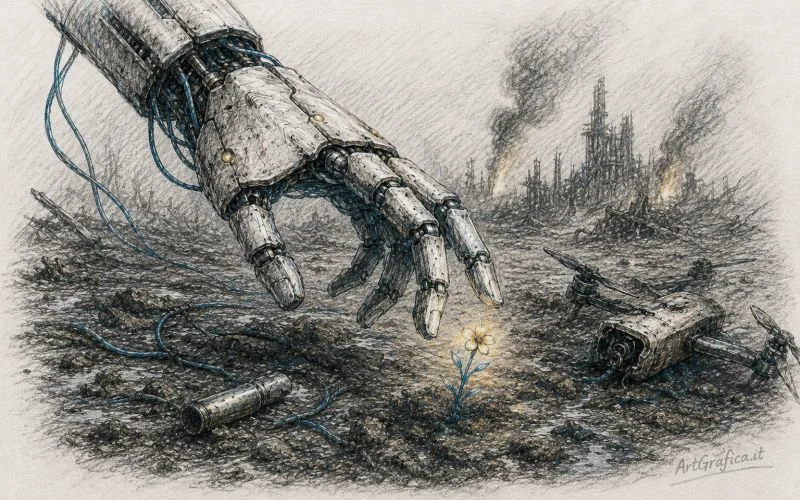
For decades, the imagination of future warfare was populated by anthropomorphic machines, autonomous armies, and scenarios that belonged more to science fiction than to strategic planning. Today, that boundary appears less clear. Not because humanoid robots have already replaced soldiers, but because some units have begun to enter, albeit in limited roles, a real operational theater. The episode concerns Ukraine, where an American startup has tested humanoid robots for logistical activities in high-risk areas. Militarily, the fact remains marginal; its weight lies elsewhere, in the way the machine begins to occupy a still uncertain space within the concrete organization of conflict.
Great technological transformations rarely appear immediately in the form that will later make them famous. The internet was born as a military and academic infrastructure before becoming the connective tissue of the global economy. Artificial intelligence was long a scientific discipline before turning into an industrial platform. Autonomous robots are appearing in much the same way, partially, imperfectly, before their function becomes fully recognizable. Their strategic value does not lie primarily in their ability to fight, but in the fact that they anticipate a different model for organizing technological power. The machine that carries ammunition is only the most visible part of an ecosystem made of data, algorithms, sensors, decision-making capacity, and operational learning.
In Ukraine, this trajectory has undergone a brutal acceleration, because war compresses the timelines of innovation. Since the beginning of the Russian invasion, the conflict has accelerated the adoption of drones, autonomous systems, and platforms based on artificial intelligence at a speed that would be difficult to observe in peacetime. Technologies that would normally require years of experimentation are tested in weeks, adapted in the field, corrected according to error, and put back into circulation. The war environment thus becomes an infrastructure of learning, where software, sensors, and decision-making models enter the same rapid cycle that once mainly concerned ammunition, vehicles, and chains of command.
The humanoid silhouette remains, in the end, an ambivalent detail. It strikes the imagination because it recalls the human being, but the decisive passage concerns the convergence between artificial intelligence and operational capability. Robots represent the physical interface of a less conspicuous transformation: the progressive transfer of cognitive, logistical, and decision-making activities toward automated systems. Every advance in artificial perception, autonomous navigation, or algorithmic planning produces effects that go beyond the battlefield and reach factories, logistics, the management of critical infrastructures, and energy systems.
The passage from the military to the civilian sphere is never automatic. The differences remain decisive, especially in the criteria of responsibility, reliability, and control. Yet technologies that learn to move in hostile, variable, and scarcely predictable environments end up modifying the way organizations think about automation. It is no longer only a matter of programming a sequence of repeatable gestures. It is a matter of entrusting technical systems with an increasing portion of contextual interpretation.
The same grammar now also concerns businesses. Amazon already uses hundreds of thousands of robots in its logistics centers, while Tesla is investing in the development of humanoid platforms initially intended for industrial manufacturing. In both cases, the objective is not simply to replace human labor, but to redefine the relationship between physical capability, information, and decision. The difference from the past is concrete: automation no longer concerns only repetitive tasks, but activities that require adaptation, interpretation of context, and coordination with complex information systems.
For management, this change has consequences that are less spectacular, but deeper. Governance, productivity, human capital, and reputation are drawn into the same movement. A technology capable of learning from the environment does not enter the company like a traditional machine, separable from the rest of the organization. It affects decision flows, required skills, the distribution of control, and internal trust. Often the problem will not be whether to automate, but which decisions can be delegated, which must remain human, and which require hybrid forms of supervision.
In the competition among states, the scale of the problem changes. The global competition over artificial intelligence is taking on characteristics that recall, in intensity and consequence, the great technological races of the twentieth century. The United States and China are investing enormous sums in the construction of computational infrastructures, advanced computing capacity, semiconductors, and training platforms. The stakes do not concern economic advantage alone. They concern the possibility of controlling the future chains of cognitive value, meaning the capacity to collect data, process them, transform them into models, and convert them into operational decisions.
The numbers do not exhaust the picture, but they anchor it to a material dimension. Global investments in artificial intelligence now exceed hundreds of billions of dollars a year, while the advanced robotics market continues to record double-digit growth rates. In the case of the startup involved in the Ukrainian tests, the research contracts obtained from the United States armed forces amount to approximately 24 million dollars. This is a limited figure compared with the major programs of American defense, but sufficient to signal an institutional orientation: experiment early, observe in the field, understand which technologies may become strategic infrastructure.
Competitive advantage, within this framework, assumes a less traditional form. For a company, as for a state, value no longer depends only on the material resources available. It depends on the ability to learn faster than others, to transform enormous quantities of data into predictive models, simulations, and decision-support systems. The true strategic infrastructure of the twenty-first century is not only physical. It is cognitive, and for this very reason it tends to shift power toward those who control the architectures of learning.
Significant technical, regulatory, and ethical limits remain. Today’s humanoids present problems of energy autonomy, reliability, and cost that limit their operational use. Many analysts believe that drones, tracked systems, and specialized platforms will continue to dominate the field for many years to come. The problem therefore takes on a more concrete form: how much decision-making space will progressively be entrusted to machines, under which constraints, with what supervision, and with what final responsibility.
Economic history shows that the most important technologies do not only change what is produced. They change the context in which decisions are made. From a tool applied to existing processes, artificial intelligence tends to become an operational environment within which strategies are defined, resources are allocated, trust is built, and power is exercised. Not everything will happen at the same time, and not everything will take the form that is most visible today. Humanoid robotics may also remain, for years, less relevant than other autonomous platforms. The underlying problem, however, is already present.
The image of a robot crossing a war zone carrying supplies matters less than the meaning it carries with it. That mechanical movement tells of the entry into a historical phase in which national security, industrial competitiveness, and the capacity to generate value will depend increasingly on the management of cognitive infrastructures. We are not facing a completed replacement of humans by machines. We are, however, already inside a phase in which organizations will have to govern an intelligence distributed among human beings, algorithms, and autonomous systems, both on battlefields and in boardrooms.