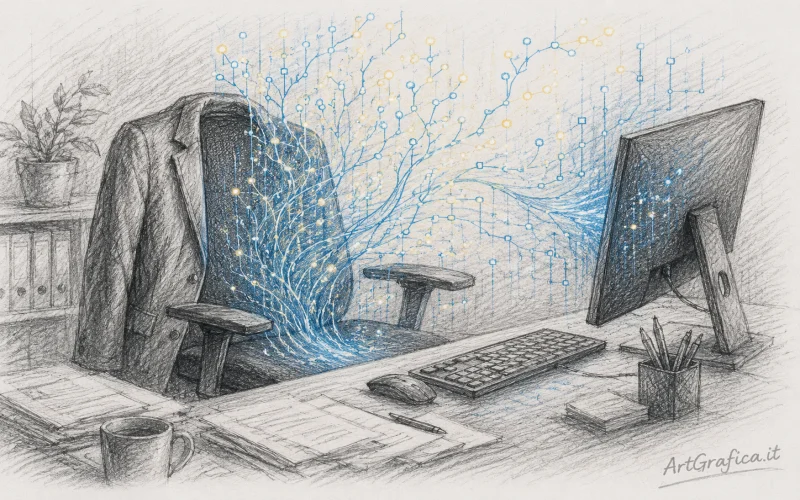
The arrival of Claude Tag in Slack should not be read as yet another integration between a piece of software and a corporate messaging platform. The news, in itself, is simple: an artificial intelligence system can be called into a channel, receive tasks, access authorized contexts, remember operational information, and work asynchronously. Its significance, however, is not exhausted by the technical aspect. A major AI infrastructure is being placed quite naturally inside the most delicate symbolic space of the contemporary enterprise: the one in which conversations, priorities, decisions, and shared responsibilities are formed.
The issue is not only about the interface. Companies have always introduced new tools into their working environments, but they have rarely made them sit, so to speak, inside the ordinary place of daily cooperation. The AI that enters a work channel does not remain outside the process, like an engine to be queried when needed. It begins to occupy a more ambiguous space, close to the memory of the group, to task management, to the continuity of information that passes from one person to another and often disperses without leaving a fully usable trace.
The history of business automation has long been a history of tools. The spreadsheet increased the manager’s calculation capacity, enterprise software ordered processes, CRM turned commercial memory into organized assets, cloud platforms made the company less dependent on its physical boundaries. Generative AI introduces a different passage, because it does not merely enhance an already defined function. It settles inside the cognitive flow of the organization and participates, with a new continuity, in the production of meaning: it summarizes, connects, suggests, remembers, anticipates, signals what risks being forgotten.
A company is not made only of people, contracts, assets, capital, and procedures; it is also made of distributed attention. Every enterprise decides what matters through a continuous sequence of meetings, messages, attachments, silences, urgencies, postponements, interpretations. When an artificial agent enters this environment on a stable basis, it does not only automate a task and does not merely accelerate an existing activity. It contributes to the selection of what deserves attention and, consequently, to the formation of internal decision-making power.
At this point, the issue no longer coincides only with the time saved. It concerns the portion of organizational intelligence that is transferred to non-human entities, or in any case shared with them in an increasingly less episodic way. It is a less visible matter than the replacement of work, but a deeper one for the life of the enterprise, because it touches the way in which a professional group remembers, orders, forgets, and assigns relevance.
The most recent surveys indicate that the use of AI in organizations is now widely diffused, but the transformation remains incomplete. Many companies experiment; few have truly redesigned their processes around agents capable of acting across several steps. It is an intermediate phase, typical of major technological transitions: innovation has already entered balance sheets, budgets, and board presentations, but it has not yet forced the company to change its moral architecture all the way down. AI is present, often visible, not always governed.
Klarna has stated that its AI assistant handled 2.3 million conversations in its first month, equal to roughly two thirds of customer service chats, with an estimated impact equivalent to the work of hundreds of operators. Moderna has brought generative AI into different functions, from research to the legal and production dimensions, building hundreds of specialized internal applications. These are different cases, and for that very reason useful: they show that the question does not concern only Big Tech or innovation departments, but the ordinary composition of the value chain.
It would be reductive to read all this solely as the mechanical replacement of human beings. In many cases, what changes is the arrangement of skills: information once dispersed among procedures, archives, individual experience, and informal memory becomes a system that can be queried, replicated, and potentially scaled. This recomposition produces efficiency, but it also produces a different internal geography of power. Whoever controls access to data, the configuration of agents, and the criteria by which AI intervenes in processes controls a growing part of the company’s operational capacity.
Management thus finds itself facing a discipline that no longer coincides with simple technological adoption. Introducing artificial agents into teams does not mean merely purchasing software licenses or authorizing the use of a new digital service. It means deciding which data may be read, which decisions may be suggested, which activities may be carried out, which controls must remain human, and which responsibilities must not be diluted behind the efficiency of the machine.
These questions no longer belong only to IT managers or ethics committees, where they exist. They enter ordinary governance, risk management, compliance, reputation, contracts, relations with clients and employees. An artificial agent working inside a team may produce a correct report, but it may also consolidate an error, make a source opaque, suggest a questionable priority, or execute too well a task that was badly framed. The quality of the output does not exhaust the responsibility of the organization that incorporates it.
Corporate reputation will increasingly be tied to the ability to demonstrate that AI not only works, but operates within a perimeter that is understandable, traceable, and consistent with the interests of clients, employees, shareholders, and institutions. This perimeter cannot be defined once and for all, because agents change with use, with contexts, with the data to which they are exposed, and with the authorizations they receive. Governance, in this field, will not be a document attached to digital transformation, but a practice of continuous maintenance.
Corporate agents do not live in a vacuum. They depend on models, cloud infrastructure, semiconductors, data centers, security standards, energy supply chains, and platforms often concentrated in a few jurisdictions. The economic sovereignty of the twenty-first century will not be measured only by the ability to produce material goods, but by the possibility of controlling the environments in which knowledge and decisions are formed. An increasingly relevant part of competitiveness will pass through infrastructures that are not seen in workshops, shops, or offices, but that determine the way in which information and judgments are organized.
For a European enterprise, the question is particularly delicate. Organizing work, memory, analysis, and assistance through agents built elsewhere is not simply the equivalent of using foreign software. It means relying on a cognitive architecture that incorporates industrial, legal, linguistic, and strategic choices matured in other ecosystems. The dependence is not only technological, because it concerns the ability to define criteria, priorities, security standards, access methods, and forms of control over the knowledge produced within business processes.
Dependence, naturally, should not be turned into indistinct alarm. No modern enterprise is completely autonomous from the global infrastructures it uses, and no advanced economy can isolate itself from the technological platforms that support contemporary productivity. AI, however, makes the problem more subtle, because it transfers dependence from the level of tools to the level of cognitive functions. It is not only a matter of where servers are located, but of who contributes to shaping the environment in which the enterprise thinks, decides, and preserves memory.
Work does not enter this transformation only as an occupational variable. It enters as professional identity. A human collaborator will have to coexist with artificial presences capable of remembering more quickly, correlating more sources, producing more variants, maintaining operational continuity without fatigue. The difference will not always be spectacular and will not necessarily coincide with immediate replacement. More often, it will emerge in details: in the preparation of a meeting, in the reconstruction of a dossier, in the first draft of an analysis, in the monitoring of open activities that no one has the time to follow continuously.
In this space, capacities that do not coincide with simple execution will become more important. Judgment, responsibility, discernment, the ability to set limits, interpretation of context, understanding of consequences that cannot be immediately measured: qualities known all along, but now called upon to confront a machine that can perform many intermediate operations well. Human value does not disappear, but it becomes less obvious. It can no longer rest only on operational competence, nor on experience accumulated as a personal archive, because both are flanked by systems capable of producing their own functional continuity.
The artificial colleague does not erase the human enterprise, but forces it to declare what it means by organized humanity. If AI enters work channels as a permanent presence, the problem is not to give it a place in the organizational chart, but to prevent the organizational chart from becoming unconsciously subordinated to its logic. The new competitiveness will arise from companies capable of using artificial agents without transforming every decision into an output, every relationship into a workflow, every responsibility into a procedure.
The difference between an augmented enterprise and an emptied enterprise will not always be evident at the beginning. It will pass through the ability to govern the intelligence introduced into processes, to keep it legible, and not to delegate to it what must remain attributable to a human and institutional will. AI may become an ordinary presence in teams. Precisely this normality will make it less deferrable to establish where assistance ends and where a new form of organizational power begins.