
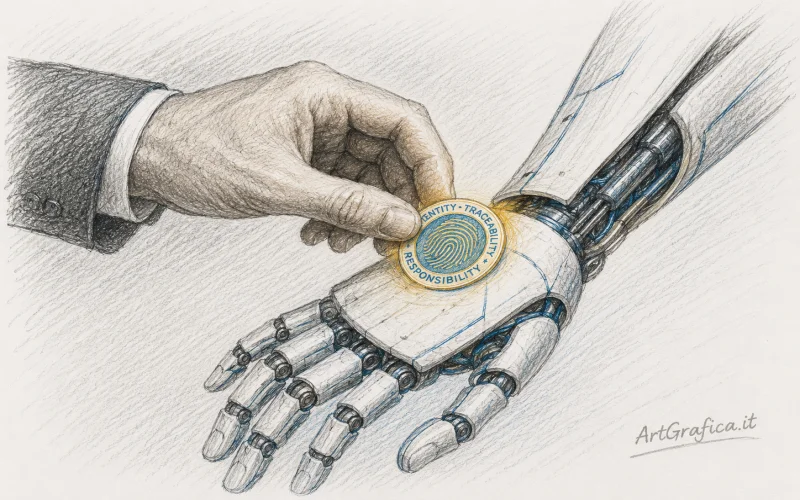
China’s decision to assign a digital identity card to humanoid robots might look like one of those stories destined to intrigue technology readers for a few minutes, before slipping into the vast archive of eccentric innovations. In reality, behind that twenty-nine-digit code meant to accompany every machine from factory floor to scrapping, something far more serious can be glimpsed: the passage of artificial intelligence from the realm of experiment into the territory of organized responsibility. A machine that walks, interacts, learns and works near human beings can no longer be treated as a simple product. It must be recognizable, traceable and accountable within a chain of decisions, maintenance operations, updates and consequences.
China has grasped this point with the pragmatism typical of large industrial systems. More than one hundred companies have already joined the national platform for managing the life cycle of humanoid robots, with over twenty-eight thousand units registered and around two hundred models recorded. The figure does not merely describe an administrative choice, but a precise vision of the future market. Before humanoids enter factories, hospitals, warehouses, offices and perhaps homes on a stable basis, Beijing is building the register that will make it possible to know who produced them, where they were sold, which components they received, which software changes transformed them, when they were decommissioned and who will be answerable if something goes wrong.
It is a lesson that concerns businesses directly, not only governments. Every company knows that what is not tracked tends sooner or later to become opaque, and what becomes opaque becomes risky. This is true of accounting, industrial quality, cybersecurity, supplier chains and the processing of customer data. The same principle is now moving toward intelligent machines. A humanoid robot is not a passive machine shut inside a safety cage. It is a physical and cognitive system that can move through spaces designed for human beings, handle objects, collect information, receive updates and modify its operating behavior on the basis of experience.
For this reason, the digital identity of robots is not a bureaucratic detail. It is the first brick of a new industrial governance. If a machine damages a product, causes an accident, collects sensitive data or displays unexpected behavior, the company must be able to reconstruct the sequence of events with the same precision now required to analyze a production defect or a cybersecurity breach. Without a technical biography of the machine, responsibility is dispersed among manufacturer, programmer, integrator, end user and provider of the artificial intelligence model. It is the worst possible situation for the market: complex enough to generate risk, confused enough to make that risk difficult to assign.
The industrial examples already under way show that the matter does not belong to science fiction. BMW has tested Figure humanoid robots at its Spartanburg plant, assessing the possibility of using them in repetitive physical activities within existing production environments. Mercedes-Benz has begun experimental use of Apptronik’s Apollo in manufacturing, especially for heavy logistics and manual tasks, with the aim of easing certain operational functions without redesigning the entire factory from scratch. In both cases, the point is not the external resemblance to human beings, often more useful to marketing than to the income statement. The point is the machine’s ability to be governed, controlled, measured and inserted into business processes where safety, continuity and reputation are worth as much as productivity.
Here a decisive managerial issue emerges. Artificial intelligence does not enter the company as an ordinary technology to be purchased, installed and depreciated. It enters as a new decision-making environment. It forces a redefinition of who authorizes a process, who supervises an outcome, who retains final control, who interprets the error and who answers before a customer, an authority or a court. A humanoid robot in a factory does not merely replace a task. It changes the internal geography of responsibility. It obliges general management, operations, human resources, legal departments, safety teams and information systems to speak a common language, which in companies is often more difficult than automation itself.
The geopolitical dimension makes the picture even more interesting. The United States retains enormous strength in private investment in artificial intelligence, with capital flows greater than those of China. China, however, has a different and less conspicuous advantage: the ability to combine manufacturing, domestic scale, technical standards and industrial policy. With an operational stock of industrial robots already close to 1.8 million units, Beijing does not view robotics as a distant promise, but as the natural continuation of its productive power. The identity card of robots thus also becomes an act of sovereignty. Whoever establishes the recognition standard may decide, in the future, which machines enter the market, which requirements they must meet and which data infrastructure accompanies their circulation.
For Western companies, this scenario contains an elegant but severe warning. Technological competition is not played only on the best product, the most powerful model or the most agile robot. It is also played on the rules that make that product acceptable, insurable, certifiable, exportable and integrable. A machine without administrative identity could become, in some markets, the equivalent of a vehicle without a chassis number, a drug without traceability, an aerospace component without certification. The future of automation will not be made only of brilliant engineering, but of registers, audits, standards, documented responsibilities and trust built before the machine even starts working.
Europe is moving on different ground, more legal than industrial. With its regulation on artificial intelligence, it has chosen to classify risks, protect rights and define obligations for those who develop and use intelligent systems. China, instead, seems to begin from the body of the machine: first it identifies the object that walks through the world, then it builds a control system around it. These are two different philosophies. One looks to the rule, the other to the infrastructure. Both, however, recognize the same fact: artificial intelligence is no longer software living behind a screen. It is becoming physical, organizational, productive and even urban matter.
Work, too, will be transformed in a way that is less theatrical and more profound than is often imagined. Humanoid robotics will not simply erase jobs in order to replace them with polished and tireless machines. It will redesign skills, chains of command, training, professional reputation and operational culture. The value of human capital will not automatically decline, but it will change form. The ability to supervise autonomous systems, read anomalies, intervene on deviations, protect data quality and preserve judgment in ambiguous situations will become more important. The worker, the technician, the department head and the manager will not disappear, just as the accountant did not disappear with the arrival of the spreadsheet. The minimum threshold of intelligence required of human work will change.
The most delicate point remains trust. No company willingly entrusts critical processes to a technology it cannot explain, control or connect to precise responsibilities. The productivity promised by intelligent automation risks remaining a figure for presentations if it is not accompanied by procedures, controls, skills and criteria of accountability. The machine can make a factory more efficient, but it can also make an unprepared organization more fragile. It can reduce operating costs, but increase reputational risks. It can free human time, but also create new dependencies on platforms, suppliers, data and standards decided elsewhere.
In the end, the identity card of the humanoid robot is a small administrative metaphor for the century to come. Every machine will have a number, but that number will speak above all of the human beings who designed it, sold it, used it, controlled it and regulated it. The real question is not whether the robot should be considered a subject, an evocative but still misleading image. The real question is preventing artificial autonomy from becoming a free zone of responsibility. In the capitalism now taking shape, intelligence will no longer be only a property of people or organizations. It will be distributed among human beings, machines, data and rules. The difference between a mature company and an improvised one will be seen here: in the ability to govern what it has automated, even before celebrating its efficiency.