For more than two centuries, the relationship between human beings and technology rested on a relatively clear distinction: machines amplified physical strength, increased speed, reduced effort, and multiplied productive capacity. From the steam engine to the computer, every industrial revolution transformed work and economic systems primarily by acting upon the world of actions. Artificial intelligence introduces a different kind of rupture. It does not merely enter processes. It enters the mental space where judgments, language, decisions, and relationships are formed.
This is why public debate continues to oscillate between enthusiasm and concern. On one hand, the scale of adoption is unprecedented. Recent research shows that the vast majority of organizations now employ artificial intelligence in at least one business function, while private investment in generative AI alone has reached tens of billions of dollars annually. On the other hand, a growing awareness is emerging that the real transformation may not concern economic efficiency alone, but the very way human beings construct their cognitive identity.
Most discussions remain focused on employment. The concern is understandable. Any innovation capable of automating intellectual activities inevitably raises questions about the future of work. Yet the issue may run deeper. Previous technologies replaced physical effort, procedures, or calculations. Artificial intelligence enters the symbolic territory where language, imagination, interpretation, and meaning are generated. It does not merely execute tasks. It responds. It argues. It appears to converse. It simulates a form of reciprocity that no previous machine possessed.
Within this shift lies a dimension that businesses are only beginning to understand. When an executive relies daily on generative AI to write reports, summarize information, evaluate scenarios, or formulate strategic options, the technology is no longer simply a productivity tool. It becomes part of an ongoing cognitive relationship. It influences the rhythm of thought, the framing of questions, and even the way problems are defined. The central issue is not whether the algorithm possesses consciousness. It does not. The real question is how continuous interaction with such systems may gradually reshape human behavior.
It is no coincidence that some of the most compelling reflections on artificial intelligence are emerging not only from technology experts, but also from philosophers, anthropologists, and religious thinkers. In recent months, the Vatican has repeatedly emphasized the importance of preserving human dignity, freedom, and moral responsibility in an age increasingly shaped by intelligent machines. The concern is not technological progress itself. The concern is the possibility that human judgment may slowly be delegated to systems designed to support it, rather than replace it.
At its core, this is a question of power. Every major cognitive infrastructure in history has transformed the mechanisms through which societies generate and distribute knowledge. The printing press reshaped the circulation of ideas. The internet revolutionized access to information. Artificial intelligence is beginning to transform the production of interpretation itself. For the first time in modern history, a growing share of cognitive activity is mediated by proprietary systems controlled by a remarkably small number of industrial actors.
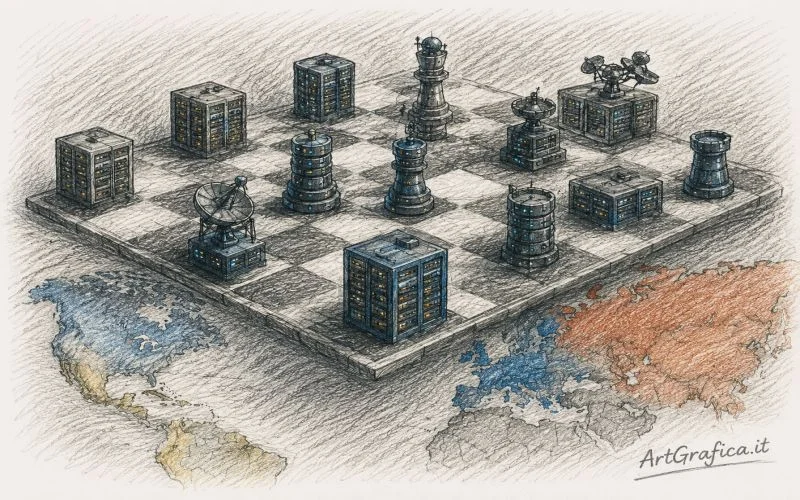
This is where the geopolitical dimension becomes impossible to ignore. Competition in artificial intelligence is not simply a race to develop better software. It encompasses semiconductors, data centers, energy infrastructure, cloud platforms, talent acquisition, and industrial capacity. Nations increasingly view AI as a strategic asset tied to economic resilience, national security, and global influence. Control over the platforms that organize knowledge increasingly translates into influence over the production of value itself.
For businesses, this transformation carries profound implications. Microsoft has integrated generative AI across its productivity ecosystem, embedding cognitive assistance into tools used daily by millions of professionals. Nvidia has become one of the defining corporate symbols of the AI era, positioning its chips at the center of a global technological supply chain. In both cases, what emerges is not merely technological innovation but the construction of new forms of industrial dependency and strategic leverage.
Inside organizations, therefore, a new managerial question is beginning to take shape. The issue is no longer limited to how much work can be automated. The more significant challenge concerns the organizational culture that develops through constant interaction with systems designed to provide immediate answers. Speed undoubtedly creates competitive advantages. Yet every acceleration contains a potential trade-off. If businesses increasingly delegate synthesis, analysis, and interpretation to algorithms, the risk is not simply the erosion of technical expertise. The deeper risk lies in weakening the critical faculties that allow individuals to distinguish between what appears plausible and what is actually true.
This concern helps explain why trust remains a central issue in the adoption of artificial intelligence. As organizations deploy AI at scale, many continue to insist on human oversight in areas involving significant responsibility. The expansion of artificial intelligence has not diminished the importance of human judgment. In many contexts, it has reinforced it. The more powerful the technology becomes, the more evident the value of uniquely human capabilities such as ethical reasoning, contextual understanding, empathy, and accountability.
Here emerges one of the defining paradoxes of our age. For decades, science fiction imagined machines striving to become human. Today’s challenge may be the reverse. Algorithmic efficiency risks becoming the implicit model to which human beings adapt themselves. Language becomes more standardized. Decisions become more linear. Relationships become increasingly functional. Emotions risk being treated as inefficiencies rather than essential dimensions of human experience. No machine imposes this transformation. It can occur gradually through habit, repetition, and familiarity.
Artificial intelligence is therefore not merely a new technology. It is a new cognitive environment. That is precisely what makes the current historical transition so consequential. Businesses debate governance. Governments discuss digital sovereignty. Investors evaluate returns. Workers worry about employment. All of these concerns are legitimate and important. Yet beneath them lies a quieter and perhaps more fundamental question: what kind of humanity will emerge after decades of daily coexistence with systems capable of simulating language, assistance, memory, and reasoning?
The defining challenge of the coming decade may not be preventing machines from becoming more like us. It may be preserving our ability to recognize what continues to distinguish us from them. The most subtle risk is not that artificial intelligence will replace humanity, but that humanity may gradually redefine itself according to the logic of the machine. Every civilization, long before it is defined by the technologies it creates, is ultimately defined by the image of the human being it chooses to preserve.