
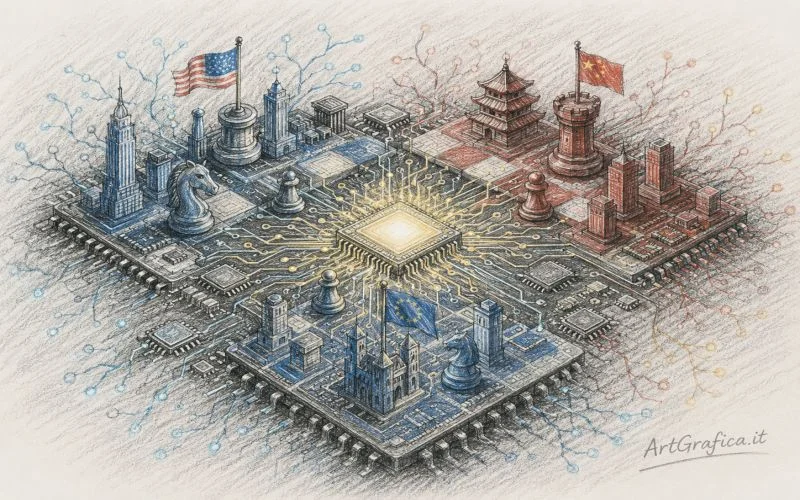
For years, artificial intelligence was presented as an infrastructure of efficiency. A productivity accelerator, a competitive advantage, a technology capable of simplifying processes and reducing costs. Today, that definition appears increasingly inadequate. AI is not merely changing how work is performed. It is reshaping the very environment in which decisions are made, economic power is distributed, and strategic advantage is built. At this stage of history, the central question is no longer what machines can do, but who controls the conditions under which the future itself is designed.
The emergence of unlikely alliances among political leaders, business executives, academics, labor representatives, and security experts offers one of the most revealing signals of the present moment. When individuals from ideological traditions that rarely share common ground begin expressing the same concerns, the phenomenon can no longer be interpreted as a technological debate. Artificial intelligence has become a systemic issue. It is no longer about software. It is about the architecture of advanced industrial societies and the mechanisms through which influence is exercised.
The speed of transformation helps explain why the discussion has become so urgent. Goldman Sachs has estimated that generative AI could affect the equivalent of up to 300 million full-time jobs worldwide. McKinsey projects that artificial intelligence may generate several trillion dollars in economic value annually. These figures do not describe the emergence of a new industry. They signal the gradual reconfiguration of nearly every existing industry. Once a technology acquires the capacity to intervene simultaneously in knowledge creation, production, design, analysis, and decision-making, it ceases to be a sector and becomes an environment.
For businesses, this shift is already tangible. Microsoft has embedded generative AI across much of its enterprise software ecosystem, transforming everyday digital tools into cognitive platforms capable of supporting managerial, administrative, and creative activities. JPMorgan Chase has deployed internal AI systems to assist research, compliance, and operational productivity across a workforce numbering in the tens of thousands. In both cases, the significance extends beyond automation. The relationship between human expertise and computational capability is being fundamentally redefined. Value no longer derives solely from the execution of work but increasingly from supervision, interpretation, judgment, and the ability to navigate complexity.
This transformation is creating a new and often invisible corporate hierarchy. Those who control models, data, and computing capacity possess an advantage that extends far beyond traditional ownership of physical assets. Access to cognitive infrastructure is beginning to play a role comparable to that once held by energy systems, advanced manufacturing, or global financial networks. The resulting competitive risk is not simply technological delay. It is structural dependence on external platforms that shape operational capabilities, access to knowledge, and decision-making capacity.
The geopolitical dimension becomes especially visible at this point. The United States and China are investing hundreds of billions of dollars in the development of artificial intelligence ecosystems, fully aware that technological leadership increasingly translates into economic and strategic leadership. Advanced semiconductors, hyperscale data centers, cloud infrastructure, and large-scale datasets have become assets of national interest. American restrictions on semiconductor exports to China and Beijing’s vast efforts to achieve technological self-sufficiency are not ordinary trade measures. They are manifestations of a broader competition centered on control over the cognitive value chains of the future.
Europe finds itself in a more complex position. It possesses world-class scientific expertise, significant industrial capabilities, and considerable regulatory influence. Yet it remains heavily dependent on platforms developed elsewhere. The debate surrounding digital sovereignty emerges precisely from this tension. The challenge is not merely to produce more algorithms. It is to preserve the capacity to define rules, standards, and priorities without surrendering strategic autonomy to external actors.
Amid this landscape, a recurring misunderstanding persists. Public discussion often focuses on whether machines will replace human beings. The deeper issue is more subtle. Organizations are not only confronting the possibility of automation; they are witnessing a transformation in the criteria through which professional value is defined. As machines become increasingly capable of processing information, synthesizing knowledge, and generating predictions, human centrality shifts toward functions that remain difficult to replicate: responsibility, strategic vision, ethical judgment, leadership, and the management of uncertainty.
Trust is becoming one of the decisive variables of this new era. An algorithm can generate an answer, but it cannot assume political, managerial, or moral responsibility for the consequences of that answer. For this reason, the future of artificial intelligence cannot be reduced to technological efficiency. It is fundamentally a question of governance. Organizations capable of integrating AI while preserving transparency, human oversight, and accountability are likely to enjoy a growing reputational advantage. Those that fail to do so may discover that technological opportunity can quickly become systemic vulnerability.
The real issue, therefore, is not the construction of ever more intelligent machines. It is the definition of the relationship between computational capability and human autonomy. Every industrial revolution has transformed the tools available to society. Artificial intelligence is different because it intervenes directly in the processes through which societies interpret reality, generate knowledge, and make decisions. That is why the debate unfolding today is not ultimately about technology. It is about sovereignty, responsibility, and power in a world where control over cognitive infrastructure may become the defining source of influence in the twenty-first century.