
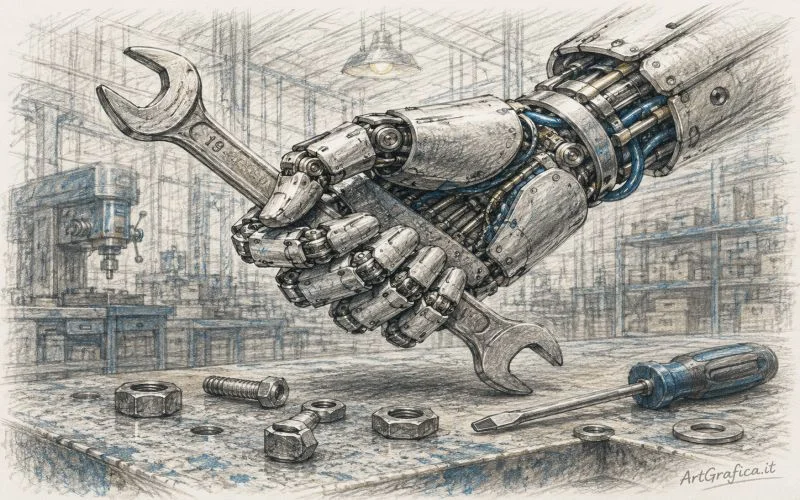
For many years, artificial intelligence was described as an almost weightless technology: models, data, cloud, algorithms, distributed computing. It seemed to belong to an immaterial world, made of screens and generated answers, invisible decisions and remote infrastructures. Now a phase of different substance is emerging: arms, legs, sensors, joints, hands capable of grasping objects and bodies designed to move through spaces built by human beings. When AI leaves language and encounters matter, it ceases to be only a cognitive machine and becomes an economic, organizational and geopolitical presence.
In the humanoid robot, form has a less decorative function than it may seem. It serves to bring intelligent automation into environments that were not designed for machines, but for people: factories, warehouses, hospitals, shops, hotels, airports, schools, homes. Doors, stairs, shelves, tools, workbenches and corridors were built around the human body; mechanical resemblance to that body reduces the cost of reconfiguring environments and transfers automation where the traditional industrial robotic arm cannot reach. There is also, naturally, a symbolic component, but the more concrete reason lies in compatibility with the world that already exists.
The economic outlook is imposing, although it must be read with the caution due to any long-range forecast. The most aggressive estimates point to an annual market close to 5 trillion dollars by 2050 and an installed base that could exceed one billion humanoids worldwide. It would be improper to treat them as an accounting of the future, because twenty-five years are a horizon in which technology, prices, regulation and social acceptance can alter many trajectories. Yet they indicate something that goes beyond statistical measurement: physical automation is returning to the center of industrial competition after a long period in which value seemed to be concentrated mainly in software, digital platforms and algorithmic advertising.
This return of the machine to productive space belongs only partly to the continuation of twentieth-century industrial robotics. The traditional robot lived within defined perimeters, often separated from human beings, designed around repetition and the safety of the line. The humanoid instead promises a more mobile, more adaptive, less confined presence. For this reason, its economic value will not depend only on unit price or on the ability to perform a task, but on the degree to which it can be integrated into processes without disarticulating the organization it is meant to serve.
For companies, adoption cannot be treated as a technology purchase to be placed downstream of strategy. A humanoid inserted into a production line, a logistics department or a healthcare facility changes the division of responsibilities, shift planning, the relationship between safety and productivity, staff training, quality measurement. Physical automation does not eliminate management; it forces it to become more precise, and in some cases more patient, because a system that acts in space exposes the company to consequences different from those of badly configured software. The error can become an accident, reputational damage, litigation, worker distrust or social rejection.
The first concrete signals are in fact coming from factories and logistics, not from homes. BMW has experimented with Figure’s humanoid robots at its Spartanburg plant in South Carolina, on repetitive and high-precision physical tasks. Amazon, while not necessarily focusing on the humanoid form as its only model, has already built one of the largest operational robotic infrastructures in the world, with hundreds of thousands of robots employed in its logistics centers. In these cases, the domestic scene of the cohabiting robot has not yet arrived, but rather the more ordinary economy of processes: moving, assembling, assisting, reducing downtime, absorbing strenuous tasks or tasks that are difficult to cover continuously.
The factory offers the machine an environment more legible than the home. Objects are catalogued, spaces mapped, procedures standardized, return on investment measurable with criteria familiar to management. In the domestic environment, by contrast, the robot encounters the minute disorder of daily life: children, animals, different floors, misplaced objects, implicit preferences, emotional risks, social expectations. This is why the vast majority of humanoids projected in long-term estimates should operate in professional contexts. The home will probably arrive, but more slowly, because there technical convenience must cross a more demanding threshold of trust.
Humanoid robotics lives on algorithms, but also on batteries, actuators, sensors, semiconductors, materials, manufacturing capacity, supply chains and production costs. It is a technology in which artificial intelligence once again meets the factory, and this explains why the contest cannot be read only through the quality of models or the power of computation. In this field China starts with a structural advantage: it has a deep industrial base, strong integration between industrial policy and production chains, a vast domestic market and an already dominant position in industrial robotics.
If generative AI has shown the power of those who control the models, humanoid robotics will make more visible the power of those who control the body of AI. The point is not only to produce machines at competitive costs, but to preside over components, standards, operational data, maintenance, updates, spare parts, certifications and industrial dependencies. A linguistic platform can influence the way knowledge circulates; a robotic platform can affect the way physical work is organized. Competition thus shifts from the attention economy to the production economy, where the supply chain counts at least as much as the model.
For Europe, and therefore for Italy, it would be reductive to confine the issue to manufacturing nostalgia or regulatory prudence, even though both belong to the continent’s industrial and cultural history. European manufacturing preserves decisive competences in precision mechanics, automation, industrial safety, collaborative robotics, medical devices and process quality. But these competences risk remaining excellent fragments if they are not connected to a common strategy on industrial data, embedded artificial intelligence, safety standards, certification and production capacity. For Europe, the choice does not consist in imitating the Chinese or American model, but in deciding whether it wants to be merely a market for adoption or also an architect of the next intelligent physical infrastructure.
The most delicate point remains human, although it does not always present itself in the most solemn terms. Calling these systems “companions” or “humanoids” can create a misunderstanding: resemblance does not coincide with reciprocity. A robot that speaks, assists, recognizes a face or accompanies a patient does not participate in the relationship in the same sense as a person. It can, however, produce real effects on loneliness, assistance, learning and the organization of services. The distinction is not academic: it serves to avoid both the naivety of those who attribute to the machine a depth it does not possess, and the laziness of those who consider it a simple neutral object.
Responsibility lies in designing contexts in which the usefulness of these machines does not impoverish the value of human presence. In a hospital, in a school, in a nursing home or in a public service, the robot can lighten procedures, guide, remind, accompany, repeat information, perform tiring tasks or tasks with low decision-making intensity. The problem, in these cases, is not to oppose human relationship to the machine, but to understand where automation frees human attention and where, instead, it risks normalizing absence, transforming an organizational deficiency into apparent innovation.
A company that adopts humanoids without questioning human capital will commit a strategic error before an ethical one. Productivity does not arise only from the automation of a task, but from the trust with which an organization absorbs change. Workers will have to be trained not only to use robots, but to understand their limits, risks, operating logic and intervention criteria. Managers will have to avoid the most dangerous illusion: believing that a general-purpose machine makes the tacit knowledge accumulated by those who truly know a department, a customer, a patient or a production line superfluous.
This also applies to reputation. Replacement perceived as blind, imposed or communicated in purely efficiency-driven language can produce resistance that no business plan fully incorporates. By contrast, integration governed with clarity can make automation a lever of quality, safety and productive continuity. What makes the difference is not only the technology adopted, but the organizational pact that makes it understandable. In many companies, the critical point will not be the robot’s ability to perform a task, but the management team’s ability to explain why that task is being automated and what space remains for human responsibility.
The year 2050 will not necessarily be populated by omnipresent humanoids. The process leading in that direction, however, has already begun, and it concerns less the spectacle of robots than the form of the productive society that will be built around them. If artificial intelligence in recent years has automated part of language, the next wave will attempt to automate part of action. When the machine takes on a body, responsibility must take on one as well: in companies, institutions, supply chains and in the culture through which it is decided what must remain human, even when it becomes technically automatable.