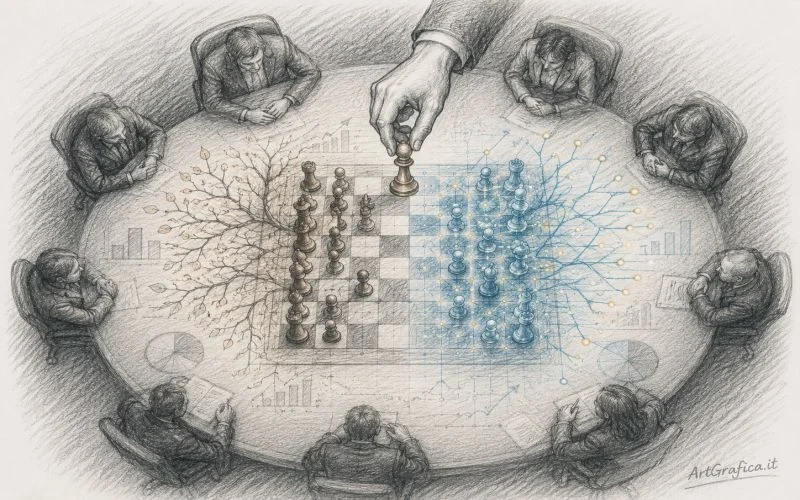
Sam Altman’s statement has the rare merit of a successful provocation: it forces everyone to look at something that was already in front of them, although many preferred to keep it at the edge of the desk. A child born today, the head of OpenAI essentially said, will never be smarter than artificial intelligence. Put this way, it sounds like an epitaph for human intellect. In reality, it is something more subtle, and perhaps more uncomfortable: it does not announce the end of humanity, but the end of its automatic superiority.
For centuries, human beings have described themselves as the ultimate measure of knowledge. Machines could be stronger, faster, more resistant, but not more intelligent. Now that symbolic agreement is beginning to crack. Artificial intelligence writes code, analyzes enormous volumes of data, produces hypotheses, summarizes documents, detects anomalies, and simulates scenarios. Then, of course, it still stumbles on banal mistakes, misunderstands elementary contexts, and invents answers with notarial confidence. The point, however, is not to photograph technology in its current state. The point is to observe its trajectory.
The numbers show that this trajectory is no longer a laboratory fantasy. In 2024, corporate investment in artificial intelligence reached 252.3 billion dollars. Private investment in the United States reached 109.1 billion dollars, almost twelve times the Chinese figure. Generative AI alone attracted 33.9 billion dollars, growing by 18.7 percent compared with the previous year. This is no longer a technological race. It is an industrial redesign.
For entrepreneurs, the issue is only apparently philosophical. If artificial intelligence becomes faster than human beings at processing information, competitive advantage will no longer depend on how many minds are assigned to a problem, but on the quality of orchestration between human minds and artificial systems. The old intelligent company was the one that had the best people. The new intelligent company will be the one that knows which decisions to leave to machines, which decisions to return to human judgment, and which ones to transform into hybrid processes.
A simple example: a medium-sized manufacturing company exporting mechanical components can use AI to forecast supply delays, read weak signals in raw material prices, generate commercial scenarios, and optimize inventory. But the decisive decision, the one that establishes whether to sacrifice margin to protect a historic client or end a relationship that has become fragile, remains an act of judgment. The algorithm calculates convenience. The entrepreneur evaluates the character of a relationship.
According to McKinsey, almost nine out of ten organizations now report regular use of AI in at least one business function, but almost two thirds have not yet truly scaled it across the enterprise. This is a revealing figure. Many companies are using artificial intelligence as a faster pen, not as a new nervous system. The difference is enormous. In the first case, a few documents are produced in less time. In the second, the company rethinks how it sells, designs, supports customers, measures risk, and trains people.
The danger suggested by Altman’s provocation is not that machines become intelligent. It is that human beings begin to be judged only according to their computable efficiency. In business, this risk is already visible. The slow employee becomes a cost. Doubt becomes friction. Prudence becomes resistance to change. Yet many of the decisions that save a company are born precisely from elements that cannot be measured immediately: a suspicion, a memory, a commercial sensitivity, the ability to read what data does not yet know how to say.
A second example concerns marketing. A generative system can produce ten campaigns, one hundred headlines, and one thousand versions of a newsletter in just a few minutes. It can test languages, segments, images, and offers. But it cannot decide on its own which promise is consistent with the deep identity of a brand. A company selling professional services does not merely risk communicating poorly. It risks becoming interchangeable, which means speaking with the average voice of the market. AI increases production. It does not guarantee positioning.
Here lies the real paradox. The more powerful artificial intelligence becomes, the more companies must return to questioning what cannot be delegated: responsibility, vision, trust, reputation, culture. The International Monetary Fund has estimated that AI could affect around 40 percent of jobs worldwide, with even higher percentages in advanced economies. The World Economic Forum predicts a profound transformation of skills by 2030, with 170 million new jobs and 92 million roles expected to disappear. This is not a linear replacement. It is a Darwinian selection of functions.
The child evoked by Altman will not necessarily grow up in a worse world. That child will grow up in a world where being intelligent will no longer be enough. Companies, in the same way, will have to stop measuring themselves by the accumulation of information and begin measuring themselves by the quality of their choices. The machine may know more, respond sooner, and calculate better. But the company that survives is not the one that abdicates its own judgment. It is the one that understands that intelligence, once it ceases to be a privilege, can finally become a responsibility.