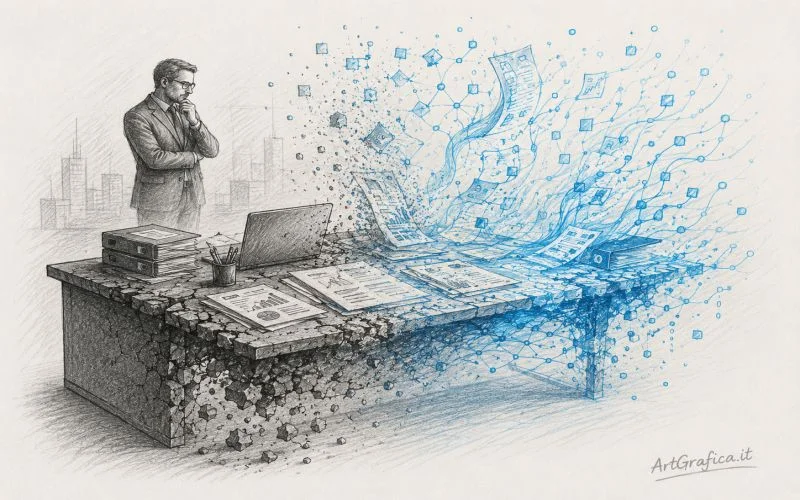
Artificial intelligence is not simply entering the workplace. It is redefining what qualified work means. For more than a century, social and professional advancement has been associated with distance from physical labor, with offices, documents, abstract expertise, and the ability to process information. Today, that very territory, once considered among the safest, appears unexpectedly exposed. Not because knowledge has lost its value, but because a significant share of its operational forms can now be translated into language, procedures, archives, summaries, and predictive models.
The most profound shift concerns white-collar professions. Legal, administrative, financial, consulting, commercial, and managerial roles have always operated through document flows: contracts, reports, emails, presentations, analyses, research, and forecasts. Large language models do not enter this environment as external tools. They enter it as systems capable of working directly with its primary raw material. Wherever work is structured around text, data, and recurring processes, automation does not need to lift objects or operate machinery. It needs to read, compare, organize, generate, and recommend.
Recent research highlights a striking gap between theoretical potential and actual adoption. Analyses of millions of interactions with AI systems show that software development and writing account for nearly half of observed usage, while approximately 36 percent of occupations already exhibit meaningful AI utilization across at least a quarter of their tasks. Even more significant is the distinction between augmentation and replacement. A substantial share of AI use enhances human performance, yet an increasing portion now involves direct task execution with minimal human intervention. It is within this grey area that productivity itself is being redefined.
Businesses understood this reality before public debate fully caught up. Morgan Stanley introduced generative AI tools across its wealth management division, achieving near-universal adoption among financial advisors and transforming activities such as research, knowledge retrieval, and client communication. Klarna reported that its AI assistant handled 2.3 million customer conversations within its first month, a volume equivalent to the work of roughly 700 customer service agents, contributing to an estimated $40 million improvement in profit during 2024. IBM, as early as 2023, announced a slowdown in hiring for certain back-office functions, identifying thousands of positions that could potentially be absorbed by automation over the following years.
These examples should not be viewed merely as efficiency stories. They are governance stories. Artificial intelligence forces organizations to decide where human judgment should remain, which processes can be delegated, what data should be accessible, what controls must be established, and where accountability ultimately resides. The challenge is not simply doing the same work with fewer people. The challenge is ensuring that organizations retain ownership of their decision-making processes rather than gradually embedding external logic generated by platforms they do not control. Productivity, at this stage, cannot be separated from operational sovereignty.
Human capital is undergoing a similar transformation. Traditional skills are not disappearing, but their value increasingly depends on where they sit within the decision chain. Skills that produce standardized outputs risk becoming commodities. Skills capable of interpreting ambiguity, evaluating context, exercising judgment, assuming responsibility, and building trust become multipliers of value. The most vulnerable professional is not necessarily the least educated one. It is the individual who mistakes credentials for protection.
In this context, many manual and relationship-based occupations appear comparatively resilient. Not because they are technologically backward, but because they remain deeply embedded in the physical world, in human presence, environmental variability, and direct interaction with people and objects. Maintenance, construction, hospitality, healthcare, logistics, and personal services require situational awareness, physical coordination, and continuous adaptation. For decades, such professions were often considered less prestigious than cognitive office work. Artificial intelligence is revealing that what is less formalized may, at least for now, be more resistant to automation.
The geopolitical dimension makes this transition even more consequential. Artificial intelligence is an infrastructure of power because it concentrates computing capacity, data, models, talent, semiconductors, cloud architecture, and regulatory influence. The United States maintains a leadership position in advanced model development and private investment. China continues to narrow the gap through industrial scale and strategic coordination. Europe seeks a distinct path built around regulation, trust, and accountability. The European AI Act, which entered into force in 2024, is not merely a regulatory framework. It represents an attempt to transform trust into institutional architecture. Yet trust without industrial capability risks becoming little more than managed dependency.
For businesses, this emerging global hierarchy of knowledge means that competitiveness will depend not only on adopting AI tools but on governing the ecosystem in which those tools operate. Whoever controls data controls part of an organization’s memory. Whoever controls models controls part of its interpretative capacity. Whoever controls platforms increasingly shapes the processes through which companies recruit, evaluate, communicate, sell, innovate, and make decisions. The strategic question is no longer whether to use artificial intelligence. It is under what conditions organizations can remain active participants rather than passive users.
The future of work, therefore, will not be divided simply between jobs that survive and jobs that disappear. It will be divided between activities reduced to procedures and activities capable of generating meaning, responsibility, and human connection. Global forecasts suggest a transformation of unprecedented scale. The World Economic Forum estimates that by 2030, approximately 170 million new jobs may be created while 92 million may disappear, resulting in a positive net balance but one accompanied by profound disruption. Behind the aggregate numbers lies the more difficult managerial and political challenge: guiding the transition without turning entire professional generations into temporary redundancies.
Viewed with clarity rather than enthusiasm or fear, artificial intelligence does not signal the end of intellectual work. It signals the end of cognitive rent based solely on information management. Value is shifting toward those capable of asking better questions, making decisions under uncertainty, safeguarding reputation, designing trustworthy organizations, and assuming responsibility when machines generate possibilities. In this emerging economy, human beings do not preserve their relevance by resisting automation. They preserve it by ensuring that automation never becomes a substitute for judgment.