For months, public debate around artificial intelligence has focused primarily on its economic consequences. Automation, productivity, job displacement, new industrial models. The numbers themselves reinforce the perception that humanity is facing a transformation without precedent. According to leading international observatories, by 2024 nearly 80% of global organizations reported using artificial intelligence in at least one business function, while private investment in the sector reached well over $100 billion in the United States alone. Artificial intelligence is no longer an emerging technology. It is becoming the invisible infrastructure through which decisions, processes, and knowledge are increasingly organized.
Yet while attention remains concentrated on employment scenarios and economic returns, a deeper question is beginning to emerge. It concerns not merely what machines will be capable of doing, but what their constant presence may alter within the psychological and cultural architecture of human beings. Every major technology has transformed behavior. The printing press changed how people thought. Television reshaped the relationship between image and reality. The internet transformed access to knowledge and compressed perceptions of time. Artificial intelligence introduces a different dynamic. Unlike previous technologies, it enters not primarily into the physical sphere of action but into the cognitive sphere of interaction.
The distinction may appear subtle, but it is profound. An engine replaces physical effort. Traditional software accelerates operational tasks. A conversational AI system suggests, interprets, synthesizes, explains, and collaborates in processes that were once almost entirely human. It does not simply perform a task. It participates in language itself, the very medium through which people construct trust, authority, identity, and meaning. For the first time, a mass technology is not merely amplifying physical capability or administrative efficiency. It is positioning itself within the continuous dialogue through which individuals understand both themselves and the world around them.
This transformation has immediate implications for business. Organizations across industries are deploying artificial intelligence in customer service, software development, data analysis, recruitment, knowledge management, and content creation. Microsoft has integrated generative AI throughout its productivity ecosystem, turning everyday tools into conversational work environments. Salesforce is building increasingly autonomous AI agents designed to interact with customers and business processes. In both cases, the shift extends far beyond efficiency gains. It alters how employees, managers, and customers relate to information, expertise, authority, and decision-making itself.
The most significant consequence, however, may not be technological at all. It may be anthropological. Human beings possess a natural tendency to attribute intention, personality, and relational qualities to entities that communicate convincingly. Cognitive psychology has documented this phenomenon for decades. When a machine responds fluently, adapts its tone, remembers context, and displays simulated empathy, the human mind instinctively activates interpretive frameworks originally evolved for interaction with other people. The machine does not become human. Rather, humans may begin to adjust aspects of their behavior in response to the machine.
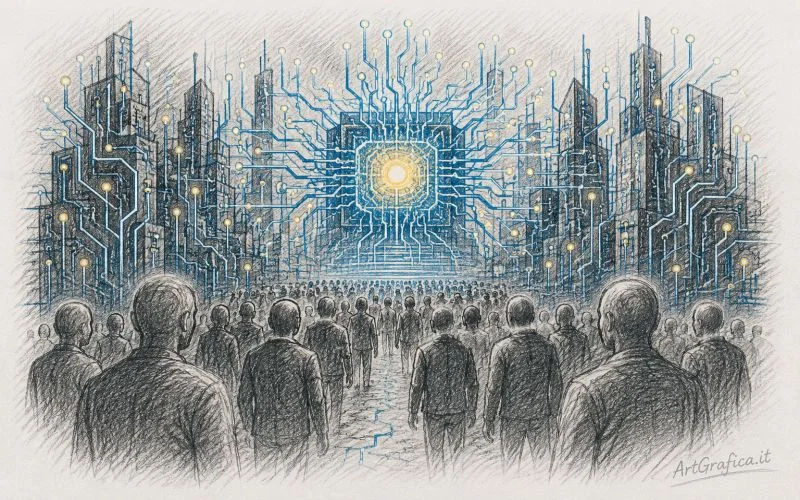
From this perspective, an underexplored question emerges for leaders and institutions. What kind of organizational culture develops when a growing share of cognitive interactions takes place through systems that possess neither consciousness, lived experience, nor moral accountability? The issue is not whether algorithms will acquire feelings. It is whether individuals and organizations gradually adapt their language, expectations, decision-making habits, and even their emotional responses to the logic of machines. Systems optimized for coherence, speed, and statistical probability may eventually become implicit behavioral models for the people who use them.
The implications extend far beyond the enterprise and into geopolitics. Artificial intelligence has rapidly become a strategic infrastructure comparable to energy networks, financial systems, and critical transportation routes. Leadership in AI is increasingly linked to national power. The United States maintains a dominant position in private investment and advanced model development. China continues to invest heavily in industrial-scale deployment and technological self-sufficiency. Europe seeks to establish regulatory frameworks capable of balancing innovation with democratic safeguards. Meanwhile, semiconductor supply chains have become matters of national security, and advanced AI models are increasingly viewed as strategic assets rather than merely commercial products.
In this environment, competition is not solely about who develops the most capable systems. It is also about who controls the conditions under which knowledge is generated, distributed, and validated. Data sovereignty, computational capacity, digital infrastructure, and cognitive influence are becoming defining elements of geopolitical power. The emerging hierarchy of nations may depend as much on control of information ecosystems as on traditional measures of industrial strength.
Yet history repeatedly demonstrates that technological superiority alone does not guarantee durable leadership. Societies thrive when innovation is balanced by institutions, ethics, and cultural resilience. Efficiency does not automatically create trust. Productivity does not necessarily generate legitimacy. Speed does not inherently produce wisdom. The most advanced technologies often reveal the strengths and weaknesses already present within the societies that adopt them.
Many organizations are discovering precisely this reality. Surveys consistently show that AI adoption is advancing faster than the organizational transformation required to extract lasting value from it. The challenge is rarely technical. It is cultural. Implementing an algorithm may be relatively straightforward. Redesigning governance structures, accountability systems, managerial practices, and workforce capabilities is considerably more difficult. The true scarcity of the AI era may not be computational power. It may be human maturity.
Perhaps the deepest paradox of artificial intelligence lies here. For decades, science fiction imagined machines striving to become more human. Contemporary reality suggests a different possibility. In environments increasingly shaped by predictive systems and statistical reasoning, the most valuable human qualities may be precisely those that cannot be replicated by computation: moral judgment, imagination, vulnerability, responsibility, intuition, and the capacity to assign meaning beyond measurable outcomes. These qualities are not remnants of a pre-digital age. They are becoming strategic assets.
The defining question of the coming decades, therefore, is not where artificial intelligence will find its place in human history. That place is already being established. The more consequential question is whether humanity will preserve its own place within a world increasingly organized around artificial intelligence. Economic disruption may dominate headlines, but the deeper challenge concerns the preservation of the distinctly human capacities that give direction, purpose, and legitimacy to every technological revolution. In the end, the greatest risk may not be that machines become more like people. It may be that people quietly begin to reshape themselves in the image of machines.