In a matter of months, artificial intelligence has ceased to be a technological curiosity and has become a structural component of corporate communication processes. It has entered operational workflows with a clear promise: speed, continuity, and the ability to produce content without interruption. In fact, that promise is being kept. In a few minutes, a draft can be obtained; in a few hours, an editorial plan can be built; in a few days, weeks of publications can be filled. The block of the blank page, which for years represented a real obstacle for those who write, is eliminated. Everything flows, everything appears simpler, everything finally seems under control.
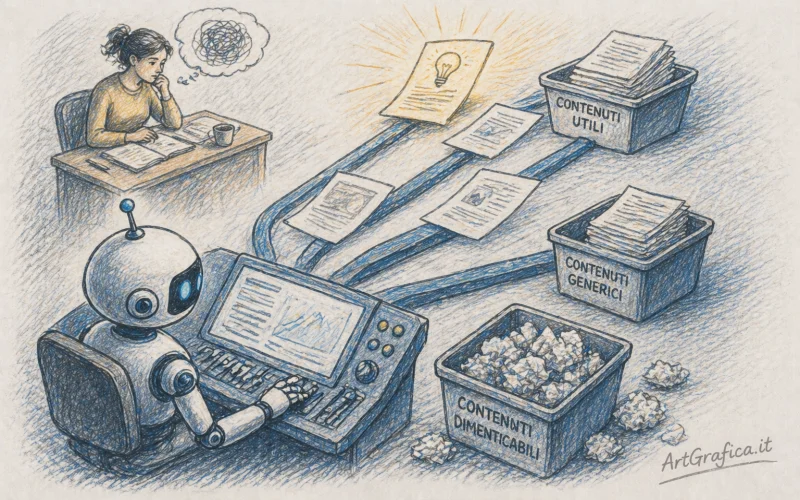
Precisely at this moment, when the feeling of efficiency is strongest, the most underestimated risk emerges. The increase in quantity is easily confused with an improvement in communication. In reality, the opposite happens: volume grows, but value does not. The content produced is formally correct, readable, orderly, but it leaves no trace. It does not build identity, it does not strengthen positioning, it does not imprint itself in the memory of those who read it. In a competitive context where attention is the scarcest resource, this amounts to a strategic problem.
It is not a matter of mediocrity, but of irrelevance. Mediocre content can be noticed, criticized, even remembered. Irrelevant content, instead, flows without friction, is consumed in a few seconds, and disappears without producing any effect. The market does not punish those who communicate anonymously; it simply ignores them. There are no obvious signals, no macroscopic errors to correct. The content exists, but it does not make an impact. This is the most dangerous form of inefficiency: the one that does not manifest itself through a crisis, but through an absence of results.
Within companies, this phenomenon takes very concrete forms. A consulting firm can increase its article production by 200%, publish regularly, maintain a presence across all digital channels, and yet record no growth in qualified demand. A retail company can generate thousands of product descriptions that are perfect from a formal point of view, without observing improvements in conversion rates. In both cases, the problem is not technical, but conceptual: the content informs, but it does not differentiate. It tells, but it does not position.
The root of this mistake is clear. Artificial intelligence is often used not as a tool, but as a substitute for thought. It does not merely support form, but is tasked with deciding the content. The machine is asked what to say, instead of first establishing what one wants to communicate. This shift is apparently harmless, but it produces a precise effect: it eliminates choice. And without choice, there is no strategy.
AI works by probability, not by experience. It returns safe linguistic formulas, already validated structures, average concepts. If the input is generic, the output will inevitably be generic. Not because of a limitation of the tool, but because of a lack of direction. In business terms, this means losing the main competitive factor of communication: recognizability.
The paradox is evident. At first, there is the impression of saving time. More is published, the process accelerates, online presence increases. But in the medium term, time is lost. Content accumulates that builds nothing, contributes to no coherent design, and does not strengthen the company’s position. Each text remains isolated, without strategic connection. The result is communication that exists, but does not evolve.
This process does not produce immediate effects. There is no sudden collapse, no obvious signs of failure. The channels remain active, the website is updated, the editorial calendar is respected. Yet something more subtle happens: trust does not grow, authority does not consolidate, identity remains indistinct. If every piece of content could belong to any competitor, it becomes impossible to build a solid relationship with the market.
At this point, a truth often misunderstood emerges. Artificial intelligence does not create identity; it amplifies it. If there is a clear vision, a defined positioning, and structured thought, AI becomes a powerful accelerator. It helps make communication coherent, maintain continuity, and develop an idea across multiple pieces of content without distorting it. In the presence of a solid foundation, technology multiplies effectiveness.
If this foundation is missing, the opposite happens. Gaps become more evident, ambiguities are amplified, and content becomes flattened. Everything appears correct, but nothing appears distinctive. In a saturated market, where competition is played out on differentiation, this amounts to a loss of position.
For a company, the consequence is clear. It is not enough to be present, it is not enough to be technically correct, it is not enough to publish continuously. Direction is needed. Choice is needed. A point of view is needed that cannot be replicated with the same effectiveness by anyone else.
Artificial intelligence can support this process, but it cannot replace it. It can organize, accelerate, and amplify, but it cannot decide what deserves to be said. This remains a human, strategic, non-delegable task.
When this order is respected, technology becomes a competitive advantage. When it is reversed, it becomes a multiplier of anonymity. And this is where the most important game of contemporary communication is played: not in the ability to produce content, but in the ability to make it truly exist in the mind of those who encounter it.