
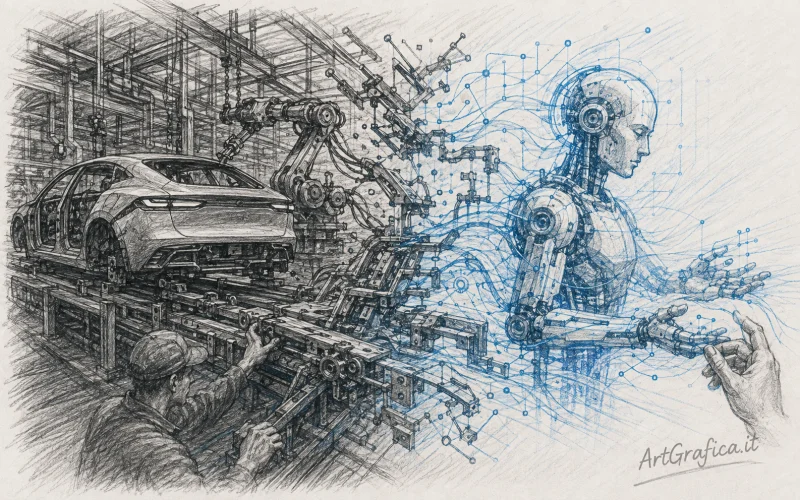
In Fremont, Tesla’s decision to dismantle the Model S and Model X production lines to install the first industrial production line for Optimus carries a significance that extends beyond a simple change of product. It marks the transition from an industry that builds machines to one that seeks to produce generalisable operational capabilities. The company has indicated a planned capacity of one million robots per year for that line and is preparing a second-generation facility in Texas designed, over the longer term, to produce ten million. These are production capacity targets, not volumes already achieved. The distance between ambition and reality remains considerable. The humanoid robot is not yet a mature product, but it already carries the weight of a strategic category.
For more than a century, automation has prospered by dividing the world into simple tasks, controlled environments and repeatable movements. The traditional industrial robot is extraordinarily efficient because its universe has been prepared for it. The humanoid approaches the problem from the opposite direction: it seeks to adapt to factories, tools, shelves, corridors and procedures designed for the human body.
Its potential economic value depends largely on this capability. If it succeeds in using existing infrastructure without requiring its complete reconstruction, companies’ fixed capital could be upgraded through an operational workforce that is more flexible than dedicated automation and transferable across different tasks. Mechanical arms and actuators, however, represent only the most visible part of the transition from dedicated automation to humanoid robots.
An industrial robot of this kind brings together artificial intelligence models, data collected in the field, computing capacity, sensors, precision components and organisational discipline. Errors feed the system, work shifts generate data, and the factory itself becomes a training environment. The factory continues to assemble the product while simultaneously teaching it how to work. For companies, the issue is already one of governance: whoever owns the operational data and controls the learning cycle also possesses the cumulative memory of the work performed.
The first industrial experiments make it difficult to dismiss the phenomenon as mere technological spectacle. BMW reports that Figure 02, deployed at its Spartanburg plant, supported the production of more than 30,000 BMW X3 vehicles over ten months, handling more than 90,000 components and taking approximately 1.2 million steps during 1,250 operating hours. These figures remain limited in relation to the scale of a major production system, but they describe a deployment integrated into the continuity of factory operations.
The replacement of a single activity describes only part of what is happening. Figure 02 must be integrated with existing safety procedures, logistics, information systems and production processes. When physical autonomy genuinely enters production, the dexterity displayed in a public demonstration becomes less central, and less visible issues emerge: standards, liability, quality, maintenance, downtime and organisational acceptance.
Mercedes-Benz is following a different but partly convergent path. At its Digital Factory Campus in Berlin, it is training Apollo, developed by Apptronik, to perform repetitive intralogistics tasks and initial component inspections. Workers’ skills are transferred through teleoperation and augmented reality; the worker’s tacit knowledge is therefore translated into machine behaviour. The process may reduce the burden of physically demanding tasks while also changing the value of human capital. Experience is captured, formalised and made replicable. Contracts, intellectual property, data security and recognition of skills therefore acquire a weight comparable to that of mechanical performance.
The geopolitical dimension is already apparent in the global scale of automation. In 2024, 542,000 industrial robots were installed worldwide, more than twice the number recorded ten years earlier, and 74 per cent of new installations were concentrated in Asia. China alone installed 295,000 units and surpassed two million operational robots in its factories. The humanoid robot is therefore entering an already asymmetrical system, in which production capacity, electronics supply chains, component availability and the speed of experimentation are unevenly distributed. Competition will concern not only the design of the model, but also the ability to manufacture, train and update it at scale.
Three different forms of industrial power emerge from this landscape. The United States possesses artificial intelligence platforms, venture capital and companies capable of integrating software and products. China combines industrial policy, manufacturing depth and a domestic market suited to experimentation; in 2026, it also introduced a national system of standards covering the entire life cycle of humanoid robots and embodied intelligence. Europe retains areas of excellence in robotics, automation and factory engineering, but risks remaining strong in components and weak in platforms. In this sector, sovereignty also depends on the ability not to entrust the design, updating and governance of physical intelligence to external actors.
In boardrooms, counting the jobs that may eventually be eliminated provides an excessively narrow measure of the phenomenon. The introduction of humanoid robots affects the architecture of the company and involves investment, insurance, cybersecurity, industrial relations, training, operational continuity and reputation. These areas are often managed by different corporate functions, which will nevertheless have to address the same technical system.
A robot capable of performing a task reliably can improve productivity and safety. An opaque system with poorly defined responsibilities can instead transform a local malfunction into a legal or reputational crisis. Assessment will require metrics less spectacular than dexterity: total cost per productive hour, frequency of human intervention, transferability across tasks, traceability of decisions, safety in interactions and the quality of the data generated. Industrial viability will depend to a significant extent on these elements.
The significance of Optimus does not depend on proving that human labour is about to disappear. The project signals that artificial intelligence is seeking an industrial body and that algorithms, sensors and actuators are beginning to share the same space as workers. The boundary between decision and action is becoming less distinct.
Competitive advantage may not belong to the company with the most anthropomorphic robot. It may favour the company capable of organising cooperation between people, systems and data without dispersing responsibility and knowledge. The factory of the future may take on a human appearance. What remains to be determined is who will control what the machines learn and towards which conception of value that learning will be directed.