
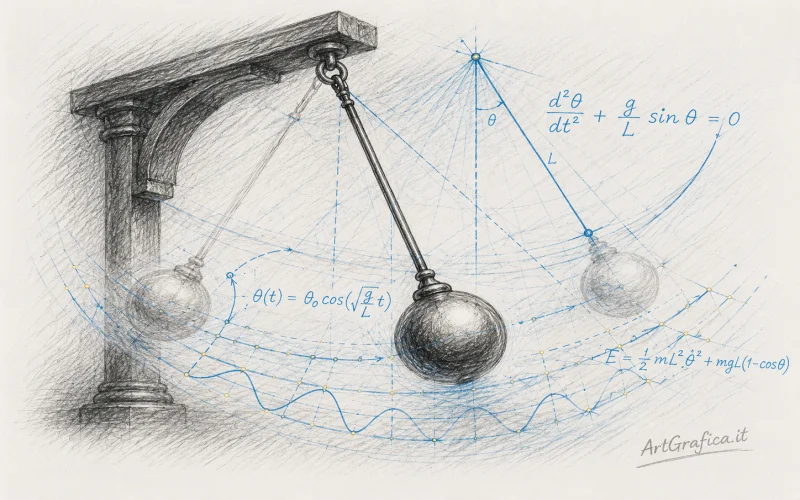
For a long time, artificial intelligence was described as a machine capable of providing answers. It consulted archives, recognised images, translated information and, more recently, produced texts with surprising fluency. Within this representation, it remained primarily a tool directed towards knowledge that had already been formed, useful for organising it, summarising it or making it available once again. For some time now, a different function has been emerging, although its boundaries remain uncertain: participating in the construction of knowledge and working even where regularities have not yet been formalised.
The difference may appear subtle; in economic and institutional terms, it is much less so. A technology that organises knowledge increases productivity; a technology that helps identify previously unformulated regularities intervenes in the economics of research and in the distribution of scientific power. AI-Newton, the system developed by a group of Chinese researchers, belongs to this second trajectory. It has not magically retraced three centuries of physics, nor has it independently observed reality as Newton might have done beneath the famous apple tree. It worked with simulated data, including statistical errors, drawn from 46 predefined experiments in classical mechanics. Starting essentially from spatial coordinates, time, objects and geometric configurations, it progressively constructed concepts comparable to velocity, mass, energy and physical constants, eventually deriving formulations attributable to Newton’s second law, the conservation of energy and gravitation.
Finding an equation capable of fitting a series of numbers is only one part of the result. Symbolic regression, employed in various forms of automated research, seeks explicit mathematical expressions rather than merely producing predictions that are difficult to interpret. In AI-Newton, the results obtained can also become concepts that are reusable in subsequent analyses. An elementary discovery thus enters the process leading to the next one, in a progression that resembles certain movements of the scientific method more than the ordinary operation of a conversational assistant.
In testing, the system identified an average of approximately 90 physical concepts and 50 general laws. It would be improper to describe it as a scientific consciousness: it remains an architecture that preserves, combines and generalises formalised knowledge, with capabilities that are still limited. The project occupies an intermediate territory, distant from human intelligence yet not reducible to the simple automation of known procedures.
Modern science has become a complex industrial machine. Laboratories, supercomputers, sensors, databases, financial capital and highly specialised expertise must be coordinated before a new hypothesis can even be tested. The main problem is not always a shortage of ideas. More prosaically, it may lie in the number of alternatives that can be evaluated, the costs required to do so and the time separating an initial intuition from a reliable experiment.
Within this system, time is not merely an academic measure. It is a cost, a competitive advantage and, in many sectors, a barrier to entry. Automating part of the process of formulating hypotheses shortens the path between data and the next experiment, even when it does not immediately lead to a discovery. For a company, this means being able to explore more alternatives, discard some of them before committing material resources and concentrate human effort on the possibilities regarded as the most promising.
Microsoft’s experience with the Pacific Northwest National Laboratory provides a concrete measure of this change. Artificial intelligence and high-performance computing systems examined more than 32 million possible materials, progressively narrowing the field until they identified a candidate for a solid-state electrolyte. The material was synthesised and used in a battery prototype. Its composition could reduce the use of lithium by approximately 70 per cent compared with conventional electrolytes.
The candidate requires further testing and does not yet constitute an industrial solution. Even without industrial success, however, the experiment already has managerial significance. The laboratory has remained indispensable; what changes is the breadth of the space that can be explored before physical verification. Millions of possibilities can be compared, organised and reduced to a set compatible with the time and cost of experimentation. A human research team would have struggled to examine a space of comparable scale using traditional procedures.
In the pharmaceutical sector, the same logic is taking the form of billion-dollar agreements. AlphaFold’s structural predictions have made more than 200 million protein models available and are used by millions of researchers. Isomorphic Labs, established within the Alphabet ecosystem to apply artificial intelligence to drug design, has entered into collaborations with Eli Lilly and Novartis whose combined potential value was reported to be almost three billion dollars, excluding royalties. These agreements therefore assign economic value to the ability to narrow the space of possible molecules, determine which experiments deserve to be conducted and reduce the number of attempts destined to fail.
This development requires companies to reconsider the governance of innovation. Public debate often focuses on whether a decision should be entrusted to an algorithm. For companies, the central issue concerns control over the entire sequence through which certain hypotheses are selected, financed and ultimately tested. Experimental data, computing power, symbolic models, intellectual property and access to laboratories now form a single cognitive infrastructure, although organisations often continue to manage them as separate resources.
Competitive advantage will depend on the ability to connect these elements rather than on the simple purchase of a software licence. The necessary skills will also be less easily contained within traditional organisational divisions. Researchers, engineers, computer scientists and executives will need to share more of the language used to evaluate results. Organisations will require people capable of understanding the scientific reliability of a formulation, its potential industrial transferability and the risks arising from dependence on external infrastructure. The timing and form of this change will vary considerably across companies and industries.
The origins of AI-Newton make it difficult to separate the scientific result from its geopolitical dimension. The project was supported by the National Natural Science Foundation of China and by Peking University’s high-performance computing platform. In parallel, the United States Department of Energy is organising programmes and infrastructure for artificial intelligence applied to science, security and energy technologies. Although different in origin and configuration, these initiatives point towards a general direction that is now clearly recognisable.
The competition is not exhausted by possession of the most powerful language model. What matters is the capacity to transform scientific data into materials, pharmaceuticals, energy technologies and industrial capability. Control over cognitive value chains is therefore entering the sphere of national sovereignty alongside raw materials, semiconductors and communication networks. The distinction between basic research, industrial policy and strategic security is becoming less clear than twentieth-century institutions were accustomed to considering it.
One caution remains necessary: a system can formulate a correct mathematical relationship without understanding the world in the human sense of the term. It can propose hypotheses without possessing curiosity, responsibility or awareness of their consequences. Experimental verification, epistemological judgement and decisions concerning the use of a discovery remain human and institutional activities. Yet it would be equally naïve to conclude that nothing has changed simply because the machine has no intentions.
The microscope does not understand what it shows, yet it transformed medicine. Here, the shift goes further: the instrument does not merely extend our vision but intervenes in the organisation of questions, the selection of hypotheses and the sequence of attempts. We do not yet know how far this function may develop. One consequence is already visible: the power to ask the most fruitful questions may shift towards actors different from those who have exercised it until now.